Archer Materials is Building a Scalable Path to Commercial Quantum Technology
Posted April 27, 2026
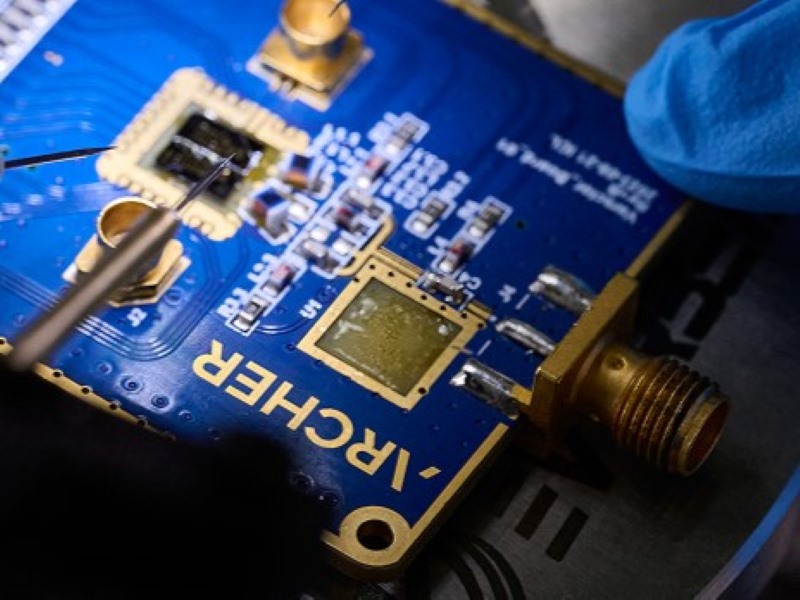
Archer Materials charts a scalable, semiconductor-ready path to commercial quantum tech with the 12CQ project, targeting a 2026 qubit.
Archer Materials, located at Lot Fourteen, occupies a distinctive position in Australia’s technology landscape as the only ASX-listed company focused on developing quantum technology.
While quantum computing continues to attract headlines for billion-dollar funding rounds and ambitious machine-building programs, Archer has pursued a markedly different strategy: develop quantum hardware components that can shrink the mammoth-sized engineering challenges facing companies building full-scale quantum machines.
Archer is focused on developing technology that can integrate with existing semiconductor manufacturing infrastructure. The ultimate goal is to license this IP through industry partnerships rather than attempting to build full-scale quantum machines in-house.
Archer is developing the intellectual property designed to slot into the established semiconductor ecosystem and produce high-value, enabling technology for the quantum ecosystem. With more than 40 patents filed globally and development partnerships spanning research institutions and industry leaders, the company has built a roadmap that emphasises manufacturability, scalability, and commercial relevance over open-ended research.
At the center of that roadmap is the 12CQ project, Archer’s carbon-based quantum computing program, which is targeting a proof-of-function qubit demonstration in 2026.
Developing qubits that are stable and scalable
Although the quantum research community and the industry has seen some fantastic progress over the last two decades, there remain massive challenges to advance the technology to a point where we have a scaled, useful quantum computer capable of doing the wonderful things touted currently. These challenges are not just improving things by 2 or 5 times.
Metrics for the qubits, the building blocks of a computer, need to improve by hundreds of thousands to millions of times current performance. Innovation is required in how these qubits are wired together, how control signals are delivered to the qubit chips, and how we read out the qubits.
This is going to be a worldwide effort to develop new materials, chip architectures, invent chip fabrication techniques, and develop new ways to integrate this into a full system. What this means is that the large players with deep pockets may lead this full-stack development, but there is a space for many companies to make up the ecosystem and contribute to this huge challenge.
Moving from proof-of-concept to manufacturable devices
Archer is developing manufacturable world-leading performance components that lower some of these engineering challenges, enabling the scaling of these hugely complex systems. In the first instance, producing qubits that can be produced in a semiconductor foundry but have superior stability can enable easier scaling of millions of these devices on one chip, as well as reduce engineering overhead associated with the complex control and readout of these incredibly fragile systems.
Archer is pursuing carbon-based components and looks to exploit the superior qualities these devices have. Quantum hardware has historically struggled to move from proof-of-concept experiments to manufacturable devices. Archer’s design philosophy begins with the premise that scalability must be embedded from the outset.
The 12CQ program is designed for semiconductor compatibility
A defining feature of the 12CQ program is that it is built using materials and processes intended to scale with today’s semiconductor fabrication methods and integrate with existing chips.
This design principle addresses one of the central economic challenges in quantum computing: capital intensity. Building entirely new fabrication ecosystems for emerging quantum architectures can require vast investment and introduce multi-year development cycles. By ensuring compatibility with established semiconductor infrastructure, Archer aims to reduce both capital requirements and time to market.
Archer’s strategy is oriented toward licensing and industry partnerships rather than constructing complete quantum computing systems itself. Under this model, value is created through intellectual property development and strategic collaboration, not through vertically integrated hardware manufacturing.
Collaboration is essential to extend the relevance of quantum capabilities
Recent collaboration agreements with organisations, including Emergence Quantum and the Commonwealth Scientific and Industrial Research Organisation (CSIRO), illustrate that partnership-led framework. In addition to advancing quantum and electronic devices, the CSIRO collaboration encompasses the development of quantum machine learning models for applications such as financial fraud detection, extending the relevance of Archer’s quantum capabilities beyond pure hardware.
Carbon quantum technology extends to quantum sensing and low-power electronics
Although quantum computing attracts the most attention, Archer’s carbon-based materials underpin a broader technology platform that extends into quantum sensing and low-power electronics.
Quantum sensing is emerging as a critical enabling technology for markets where high sensitivity, energy efficiency and miniaturisation are essential. Applications span artificial intelligence hardware, data centres, Internet of Things (IoT) devices, autonomous systems and medical technologies.
Archer is leveraging the same carbon-based quantum expertise developed for 12CQ to build prototype quantum sensing devices, with application identification and early market validation underway ahead of prototype development in 2026.
The ability to apply a common materials foundation across computing and sensing reinforces the company’s platform narrative. Rather than pursuing isolated technology bets, Archer is developing a versatile carbon-based base layer that can serve multiple advanced markets. This shared foundation supports capital efficiency and knowledge transfer between programs.
The Biochip: near-term commercial pathway in medical diagnostics
While quantum computing and sensing represent long-term structural opportunities, Archer’s Biochip program provides a near-term commercial pathway in medical diagnostics.
The company is developing a biosensor designed to measure blood potassium levels from a finger-prick sample, enabling regular point-of-care and at-home monitoring for hyperkalemia – a life-threatening condition of potassium imbalance that is common among patients with chronic kidney disease and heart disease. Globally, hundreds of millions of people live with chronic kidney disease, and infrequent laboratory testing can increase the risk of life-threatening complications associated with abnormal potassium levels.
The Biochip program has advanced through key technical milestones. Archer has demonstrated that its sensing technology can be built with silicon, originally in graphene devices, with faster readout times in collaboration with IMEC, one of the world’s leading semiconductor research organisations. Achieving integration onto silicon is significant because silicon remains the dominant material platform across the semiconductor industry, enhancing the pathway to manufacture and commercialisation.
In addition, the Biochip has met blood potassium testing accuracy requirements aligned with clinical standards, strengthening its pathway toward regulatory preparation and eventual trials. The company is targeting a lab demonstrator in early 2026, followed by a prototype sensor suitable for clinical trials later in the year.
Importantly, the Biochip is positioned as a sensing platform rather than a single-product endpoint. Beyond potassium monitoring, Archer is building feasibility data to extend the technology into other applications across human health, industry and ag-tech.
Three core quantum programs to deliver milestones in 2026
Archer’s three core programs: quantum computing, quantum sensing and Biochip diagnostics, are progressing along parallel commercial pathways from proof-of-concept to demonstration, then partnership or licensing arrangements.
In quantum computing, the company is targeting a carbon-based qubit demonstration in 2026 alongside continued development of quantum machine learning capabilities – software to complement the hardware programs. In quantum sensing, prototype development and market validation activities are planned for 2026 as the company defines its go-to-market approach. In diagnostics, the Biochip prototype is expected in 2026, with clinical trial preparations and regulatory steps following.
The convergence of these milestones places 2026 as a critical inflection period. Multiple demonstrators across distinct technology verticals have the potential to validate the scalability and versatility of Archer’s carbon-based semiconductor platform.
As Archer pursues 2026 demonstrations across computing, sensing, and diagnostics, its central thesis remains consistent: quantum technology will scale not only through scientific breakthroughs, but through compatibility with the semiconductor infrastructure that already underpins the modern digital economy.
Great things come to those who subscribe
Subscribe
"*" indicates required fields
Adelaide 5000
Developed by Frame Creative
© Lot Fourteen All Rights Reserved